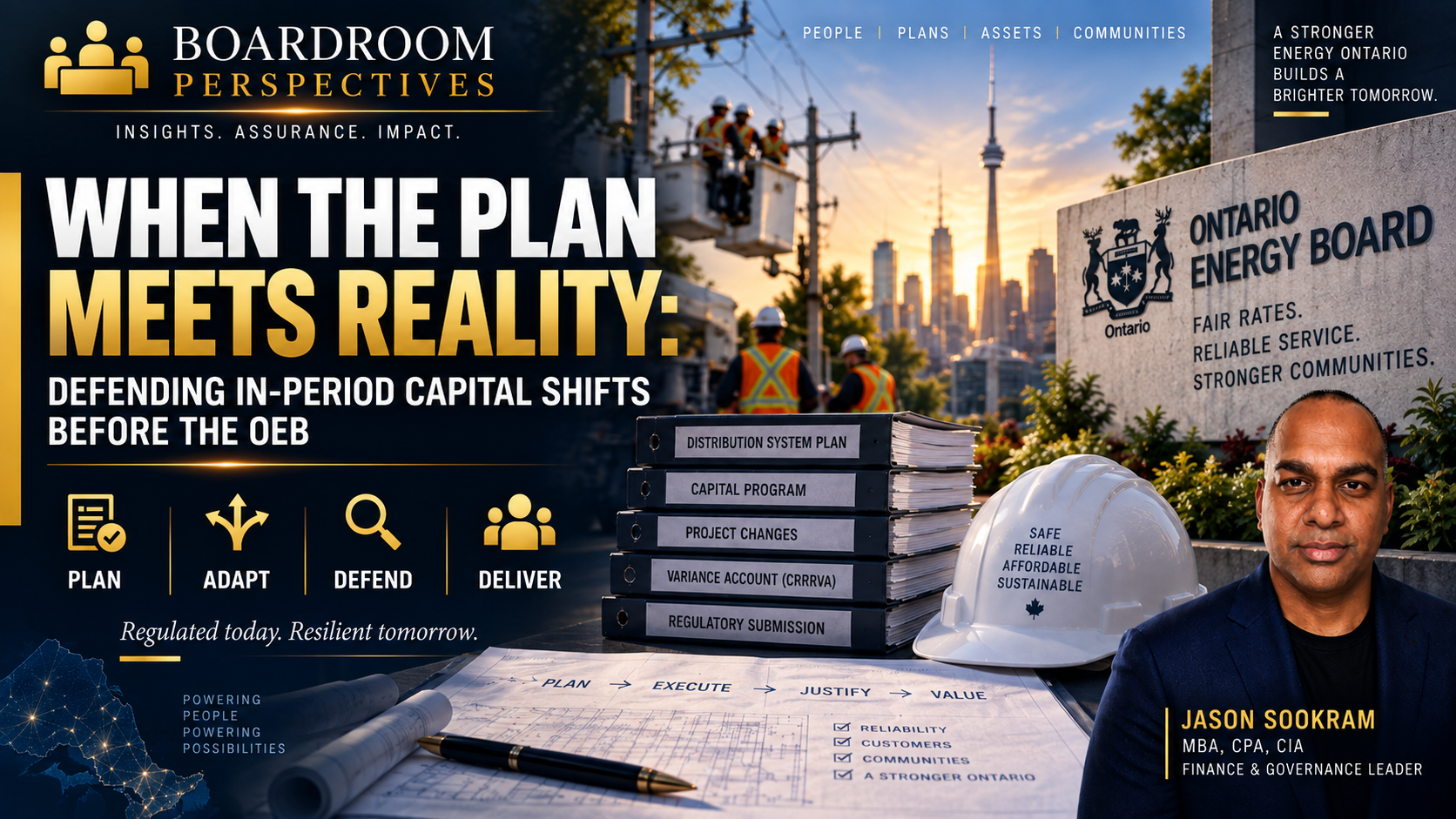
Every utility regulatory and audit leader understands an operational reality: setting a five-year capital plan is a regulatory necessity, but executing that plan without variance is practically impossible.
In Ontario, Local Distribution Companies (LDCs) file comprehensive Distribution System Plans (DSPs) to support multi-year Custom Incentive Rate-setting (Custom IR) or Cost-of-Service applications. These multi-year roadmaps lay out projected investments across system renewal, system service, general plant, and customer connections.
Then real-world conditions intervene:
- Municipal transit and roadwork alignments shift unexpectedly.
- Global supply chain constraints leave specialized station transformers stranded in procurement queues.
- Accelerating fleet electrification and large industrial load connections demand emergency feeder reinforcements.
When actual capital deployment diverges from the filed DSP, utilities enter complex regulatory territory. Intervenor groups and the Ontario Energy Board (OEB) closely evaluate in-period project deferrals, budget shifts, and project substitutions.
For a Director of Regulatory Affairs or a Director of Internal Audit, this dynamic poses a central operational question: How does a utility maintain tactical execution on the ground without exposing its rate base to capital clawbacks, cost disallowances, or asymmetric variance account reconciliations?
The Regulatory Exposure: Project Substitution vs. Ratepayer Value
Under multi-year frameworks—such as Custom IR mechanisms governing large distributors like Toronto Hydro, or cost-of-service rebasing frameworks typical of mid-sized utilities like Burlington Hydro—customer rates reflect a capital-related revenue requirement tied to a specific investment forecast.
When operational realities require reallocating capital from delayed projects to emerging reliability priorities, utilities face distinct regulatory risks:
- The Double-Recovery Challenge: Intervenors routinely examine whether a project deferred to a subsequent rate cycle risks charging customers twice—once during the initial plan period and again when re-filed in a subsequent application.
- Asymmetric Capital Variance True-Ups: Variance mechanisms (such as the Capital-Related Revenue Requirement Variance Account, or CRRRVA) are designed to credit customers if in-service additions fall short of forecasts. If an alternative, substituted project is deemed imprudent or insufficiently supported, the capital spend risks remaining on the balance sheet without earning a regulatory return.
- The No-Hindsight Evidentiary Test: Under established Canadian regulatory law (OEB v. OPG), utilities enjoy no legal “presumption of prudence”—the burden of proof rests on the applicant. The OEB evaluates whether a business decision was reasonable based on facts management knew or ought to have known at the time the decision was made. Constructing an after-the-fact narrative years later during a rebasing hearing often falls short of the necessary evidentiary threshold.
The Audit Gap: Financial Compliance vs. Regulatory Prudence
Internal Audit teams routinely perform financial control assurance. They verify that competitive procurement thresholds were observed, invoices match purchase orders, and asset capitalization follows International Financial Reporting Standards (IFRS).
While these baseline controls are essential, they do not resolve core regulatory risks.
OEB panels and intervenors rarely challenge whether an invoice was legitimate or whether equipment was placed in the ground. Instead, they examine:
- Was the in-period reallocation economically and operationally justified compared to available alternatives?
- Did the substituted project deliver commensurate reliability or capacity benefits to the specific customer classes funding the plan?
- Is there contemporaneous, documented evidence showing how the decision balanced cost, safety, and operational reliability?
If internal audit scopes stop at transactional compliance, the organization remains vulnerable to regulatory disallowances.
A Governance Framework: Audit-Proofing Capital Execution
To maintain alignment between field execution, internal controls, and regulatory filings, utility leaders should consider three core practices:
- Defined Substitution Gating and Materiality Thresholds
- The external driver prompting the change (e.g., municipal delays, equipment lead-time shifts).
- The comparative evaluation that led to the substitute project.
- The quantitative customer and reliability impact (e.g., avoided equipment failure risks, asset condition indices).
- Contemporaneous Prudence Records
- Integrated Regulatory-Audit Reviews
Moving from Defensive Posture to Strategic Agility
In an era of rapid grid transformation, capital allocation flexibility is essential. However, increased flexibility requires structured internal governance.
When Regulatory Affairs and Internal Audit establish integrated change-control processes, verifiable project substitution governance, and real-time evidence retention, they create a clear institutional benefit: the agility to adapt grid operations effectively while safeguarding rate-base investments, maintaining shareholder capital, and upholding ratepayer equity.
Question for regulatory, audit, and utility finance leaders: How is your organization currently documenting in-period capital trade-offs to withstand intervenor scrutiny?