Utility boards frequently ask when their organizations will become automated, data-driven enterprises. Yet beneath high-level digital transformation roadmaps, daily operations across North American and Ontario Local Distribution Companies (LDCs) remain tethered to manual spreadsheets, static GIS extracts, and paper-heavy engineering closeouts.
The barrier is rarely a lack of pilots. It is The Pilot Paradox: an endless cycle of proof-of-concept projects that succeed in isolated sandboxes but stall before entering production.
They stall because they are typically designed either by data scientists detached from physical grid mechanics, or by functional managers lacking the regulatory and audit pedigree to satisfy OEB prudence and capitalization standards.
Moving from experimental AI to auditable enterprise automation requires aligning engineering operations, regulatory accounting, and internal risk.
The Operational Frontline: Deterministic AI for the Grid
Field operations and asset management represent the vast majority of an LDCâs revenue requirement and physical risk. In high-voltage environments, probabilistic "best guesses" are dangerous. Practical automation must be deterministic, transparent, and auditable.
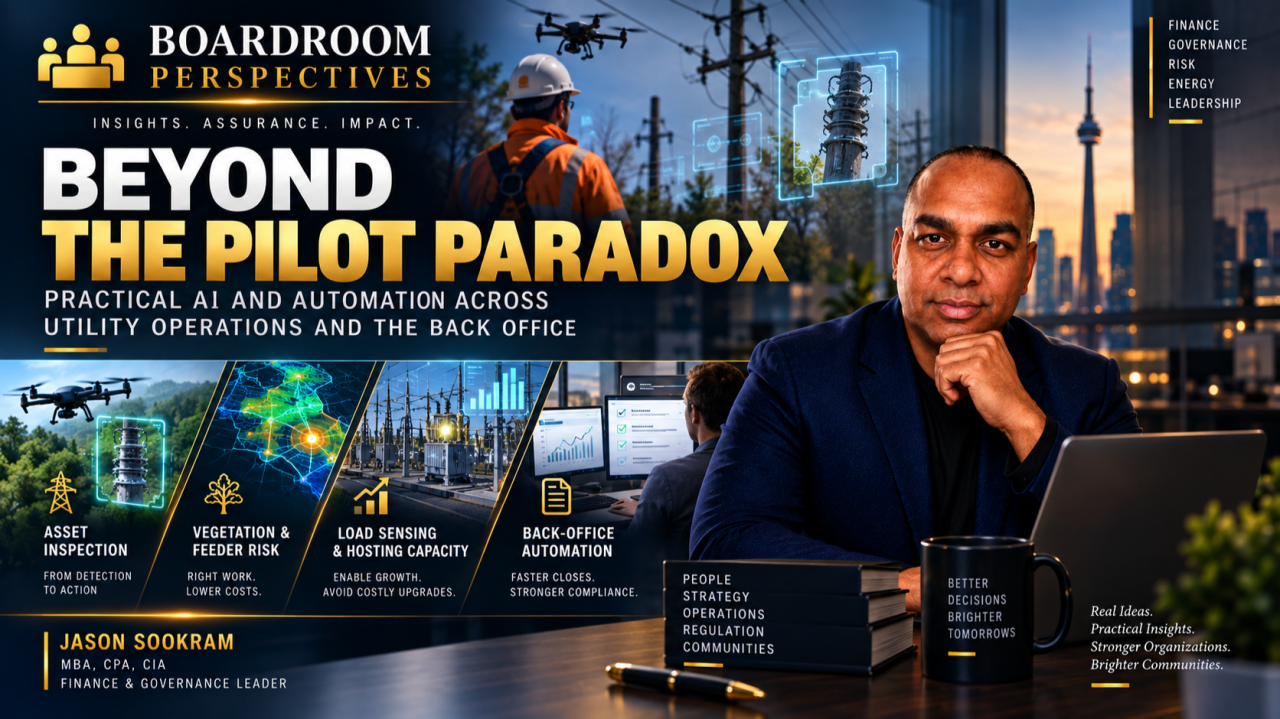
- Computer Vision Asset Triage: Rather than relying on calendar-based inspections or running equipment to failure, computer vision models ingest imagery from drone flights, bucket-truck cameras, and LiDAR surveys. The algorithms identify hairline insulator cracks, pole rot, and transformer rust, automatically triaging anomalies and populating maintenance work orders before an in-service failure occurs.
- Intelligent Vegetation & Feeder Risk Modeling: Cycle-based tree trimming consumes heavy OM&A budgets with uneven reliability results. Machine-learning models combining satellite canopy telemetry, localized weather history, and historical circuit fault logs allow utilities to dynamically dispatch trimming crews to high-risk spansâdirectly mitigating SAIDI and SAIFI while avoiding wasted operating spend.
- Dynamic Hosting Capacity & Substation Load Sensing: As localized EV adoption and distributed solar destabilize traditional load curves, static distribution planning falls short. Algorithmic load sensing predicts feeder constraints dynamically, allowing operators to optimize DER integration and defer multi-million-dollar reconductoring projects.
The Corporate Back Office: Closing the Productivity Drag
While operational technology automation captures executive headlines, the back office absorbs thousands of manual labor hours in compliance overhead, project reconciliation, and reporting.
- Accelerated CWIP to Rate-Base Conversion: One of the most chronic balance-sheet drags is the delay between physical project completion and accounting unitization. Automated 3-way matching connects field contractor tickets, inventory issues, and GIS coordinates into ERP asset classesâshrinking the Capital Work-in-Progress (CWIP) backlog and ensuring assets enter the rate base without multi-quarter amortization lags.
- Governed RAG for Regulatory Interrogatories: Defending a Cost-of-Service or Custom IR application requires responding to hundreds of intervenor questions under compressed deadlines. Private Retrieval-Augmented Generation (RAG) models, operating strictly behind corporate firewalls, index decades of previous rate applications, OEB decisions, and Distribution System Plans (DSPs) to draft precise, cross-referenced answers in minutes rather than days.
- Supply Chain Lead-Time Sensing: Global transformer and breaker lead times remain volatile. Predictive procurement models analyze vendor fulfillment telemetry and macro material indices, alerting project managers to delivery drifts before line crews are deployed to the field.
The Three Executive Guardrails
Deploying automation in a rate-regulated utility is fundamentally different from rolling out tools in an unregulated commercial enterprise. Scale requires three governance guardrails:
- Deterministic Business Logic Over "Black Box" Outputs: Critical engineering and accounting workflows cannot rely on unverified probabilistic AI. Systems must embed strict deterministic business rules and human-in-the-loop sign-offs to pass technical safety reviews and OEB prudence tests (OEB v. OPG).
- Air-Gapped IT/OT Boundaries: Data pipelines bridging operational SCADA/AMI historians with back-office analytics must feature zero-trust architecture, satisfying NERC CIP standards and preventing operational technology networks from touching public cloud environments.
- Regulatory Accounting Alignment: Automation contracts must be engineered upfront to distinguish between capitalizable integration assets and cloud OM&A. Failing to structure these investments correctly risks inflating operating costs against OEB efficiency stretch factor benchmarks.
Transforming Intent into Enterprise Value
Automation is not a software procurement exercise; it is an operating model transformation. It fails when treated as a disconnected IT initiative, and it thrives when led by executives who understand how field execution, internal controls, and rate-case defense intersect.
The utilities that lead the next decade will not be those with the most proof-of-concept slide decks. They will be the ones that embed auditable, governed automation across their core workflowsâprotecting ratepayer capital while building an agile, modern distribution business.
Executive Reflection: Where is the widest automation gap in your utility todayâon the physical feeder or inside back-office capital workflows?