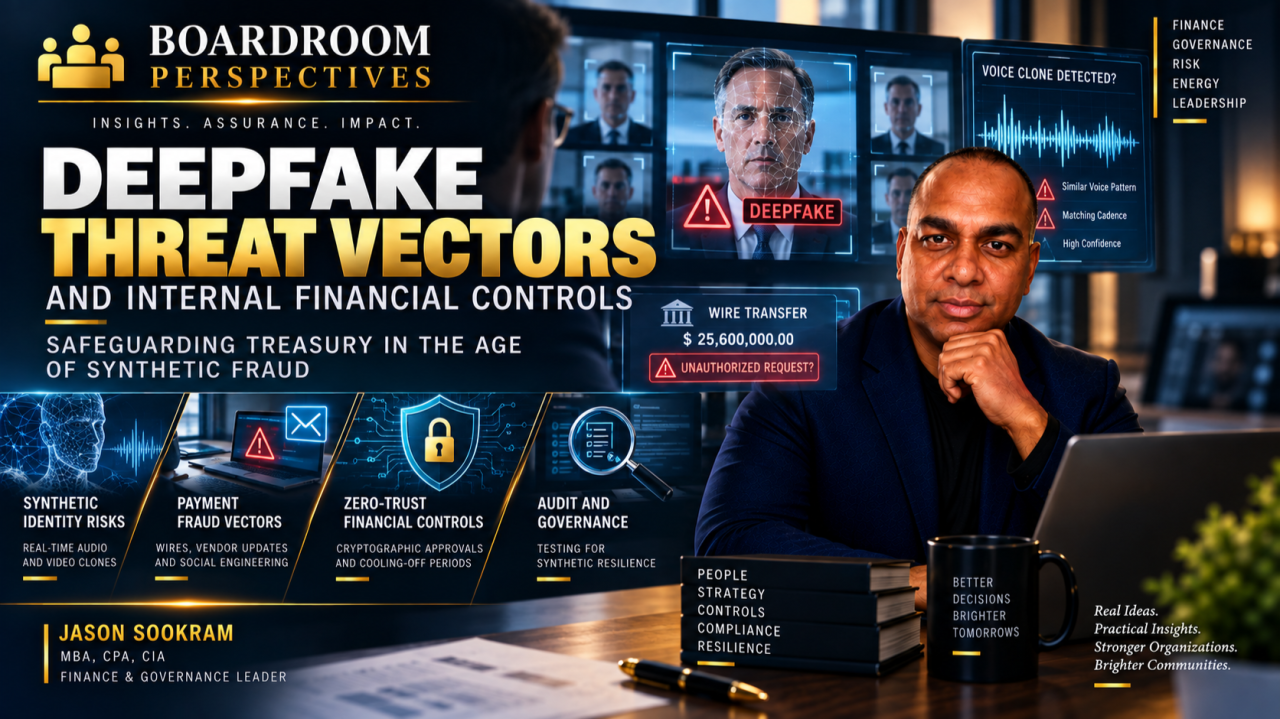
For decades, the ultimate defense against corporate payment fraud has been human verification. When an unexpected email requested an urgent wire transfer or a multi-million-dollar capital disbursement, internal controls mandated a simple circuit-breaker: pick up the phone, verify the voice, or jump on a video call with the Chief Financial Officer.
That control is officially broken.
The rapid proliferation of real-time generative audio synthesis and high-fidelity video avatars has turned visual and vocal familiarity into an active vulnerability. In enterprise environments, corporate executives have an unavoidable public biometric footprint: hours of high-definition audio and video from earnings webcasts, regulatory hearings, industry panels, and media appearances. With as little as three seconds of clean audio, modern generative models can clone an executive's voice with alarming acoustic fidelity, inflection, and cadence.
The benchmark for this threat vector is no longer theoretical. Multinational engineering and infrastructure firms have already suffered eight-figure lossesâincluding a documented $25.6 million wire fraud where a finance controller joined a live video conference populated entirely by synthetic deepfakes of the corporate CFO and executive colleagues.
For CFOs, Treasurers, and Audit Committee chairs operating across capital-intensive industries and regulated utilities, synthetic identity fraud is not an IT security issue. It is a material breakdown in internal controls over financial reporting (ICFR) and capital gating governance.
The Breakdown of Traditional "Four-Eyes" Principles
Internal control frameworks (such as COSO and Canadian NI 52-109 / SOX equivalents) are designed around the Segregation of Duties (SoD) and independent human confirmation. Deepfake attacks succeed not by hacking firewalls or breaching bank encryption, but by exploiting the psychological fault lines in human authorization chains:
- The Illusion of Out-of-Band Verification: When an employee follows policy by initiating a callback or joining a video call to confirm payment details, they believe they have executed an independent verification. When the recipient on the other end is a real-time synthetic clone, the control itself becomes the weapon that legitimizes the fraudulent disbursement.
- Pretexting and Authority Bias: Fraudsters systematically combine synthetic audio or video with artificial urgencyâciting emergency regulatory deadlines, confidential M&A negotiations, or unannounced capital equipment deposits. Authority bias suppresses an employeeâs willingness to challenge discrepancies, particularly when visual and vocal cues appear unmistakable.
- Master Data Manipulation: Threat actors increasingly target vendor master files rather than one-off emergency wires. A cloned executive voice calling procurement or treasury to "confirm" an emergency update to a major contractor's banking coordinates permanently diverts recurring capital disbursements under the radar of automated ERP anomaly triggers.
Engineering Zero-Trust Financial Controls
Protecting the corporate balance sheet against generative impersonation requires a fundamental governance shift: visual presence and vocal recognition can no longer serve as authorization triggers. Enterprise treasury must transition from "human trust" to "cryptographic zero-trust."
- Elimination of Verbal and Visual Wire Authorization Corporate treasury policies must explicitly state that no financial transaction, wire release, credit facility draw, or banking coordinate change may be approved via phone, voicemail, or video conference, regardless of executive seniority. Spoken authorization must be treated under audit guidelines as non-evidentiary.
- Dual Cryptographic Out-of-Band Authentication Every manual capital disbursement exceeding defined materiality thresholds must require multi-factor cryptographic sign-off through dedicated enterprise channels. Approvers must authenticate using hardware-based FIDO2 tokens or enterprise-managed public-key infrastructure (PKI) embedded directly inside the ERP or treasury management system (TMS). If an approval cannot be cryptographically validated through secure enterprise infrastructure, funds do not move.
- Out-of-Band Challenge Protocols with Dynamic Secrets Where verbal confirmation is mandated as a secondary check, organizations must eliminate static questions (such as employee IDs, birthdays, or public corporate history) which generative scraping tools uncover effortlessly. Treasury desks must implement dynamic, daily rotating out-of-band secret keys or mathematical challenge-response protocols managed strictly inside an air-gapped system.
- Hard-Coded Cooling-Off Windows on Master Data Changes Changes to banking details for contractors, OEMs, or escrow accounts must trigger an automated, non-overridable 48-hour to 72-hour cooling-off lock. During this holding window, independent verification must be routed to pre-established, physically documented contact pointsâcompletely segregated from the communication channel that requested the update.
The Internal Audit Mandate: Auditing for Synthetic Resilience
Internal Audit cannot evaluate fraud controls through legacy walkthroughs that ask whether "dual signatures were obtained." Audit leaders must actively test how the organization behaves when presented with convincing authority:
- Social Engineering and Synthetic Voice Simulation: In coordination with external assurance providers, Internal Audit should commission simulated voice-cloning penetration tests targeting accounts payable and treasury teams to evaluate whether staff strictly follow out-of-band protocols under simulated executive pressure.
- Threshold Integrity and Aggregation Audits: Attackers routinely structure fraudulent disbursements just below mandatory dual-approval thresholds (e.g., initiating four $245,000 wires instead of one $1,000,000 wire). Internal Audit must evaluate whether automated treasury controls flag rapid, sequential payments to new or modified beneficiaries.
- Board and Audit Committee Reporting: Audit Committees must require management to present a dedicated risk assessment on synthetic impersonation exposure, benchmarking current treasury controls against evolving generative AI capabilities.
Restoring Integrity to Financial Authorization
The human voice and face, long regarded as the definitive marks of personal identity, are now easily forged digital assets.
In this environment, an organization that relies on visual confirmation or verbal reassurance from leadership is operating without internal controls. Protecting enterprise value and safeguarding shareholder capital requires stripping human biometric trust out of the payment chain entirely.
By hard-coding cryptographic authorization, enforcing unbending cooling-off periods on vendor modifications, and auditing for synthetic fraud resilience, executive leadership ensures that when technology erodes the credibility of our senses, the balance sheet remains impenetrable.
Executive Reflection: If your finance team received an urgent video call from the CFO directing a time-sensitive capital deposit today, do your existing internal controls prevent that transfer from executing?