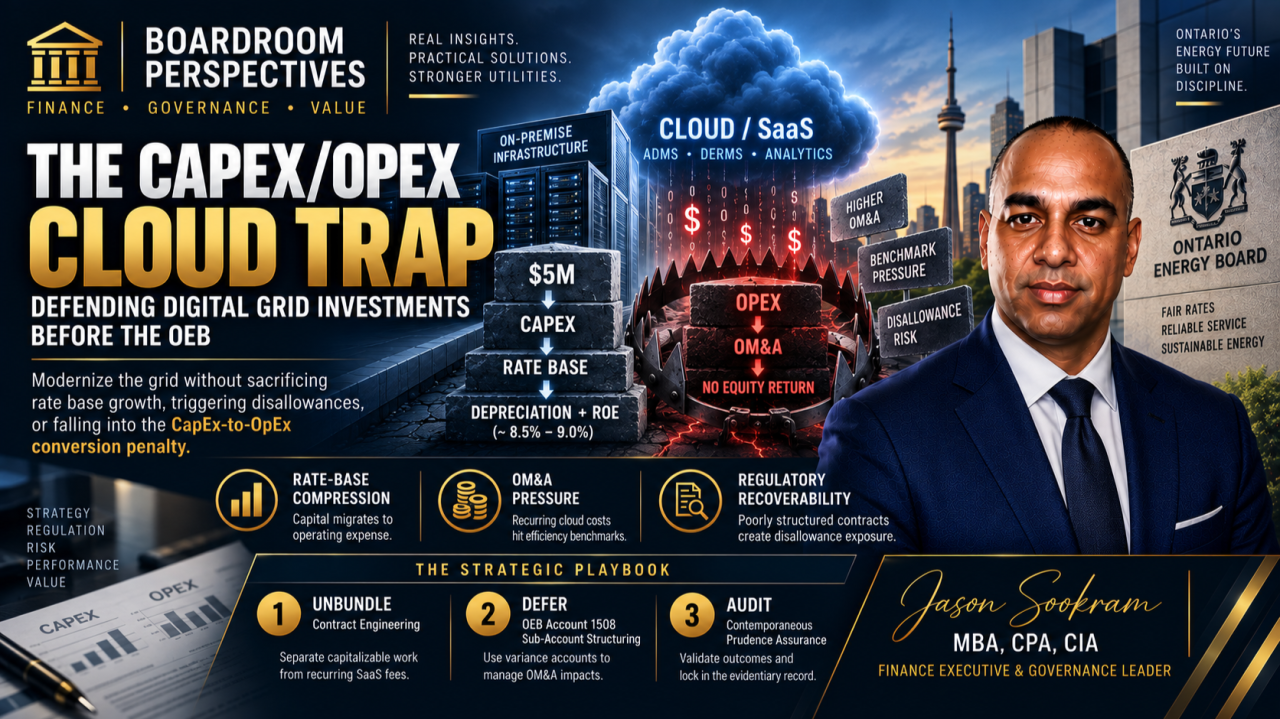
For regulatory and internal audit leaders across Ontarioâs Local Distribution Companies (LDCs), grid modernization has opened an acute balance-sheet fault line: the CapEx-to-OpEx conversion penalty.
As utilities swap legacy on-premise hardware for Advanced Distribution Management Systems (ADMS), DERMS, and predictive analytics, physical assets are vanishing into Software-as-a-Service (SaaS) and cloud agreements. In unregulated enterprises, SaaS is a clean operational efficiency play. In rate-regulated distribution, however, moving spend from capital to operating expense strikes directly at utility revenue requirements, shareholder returns, and multi-year efficiency benchmarks.
For a Director of Regulatory Affairs defending a Custom IR or Cost-of-Service plan and a Director of Internal Audit reviewing capital gating controls, the operational mandate is clear: deploy modern digital systems without compressing rate-base growth, tripping OEB econometric benchmarks, or triggering disallowances during hearing cross-examination.
The Balance Sheet Friction: ROE Destruction vs. OM&A Ceilings
Under traditional rate-making principles, utility capital expenditure (CapEx) enters the rate base, earning depreciation recovery and an equity return of roughly 8.5% to 9.0% regulated ROE. Operating, Maintenance, and Administrative (OM&A) expenses, by contrast, are recovered dollar-for-dollar without an equity return.
Consider the operational contrast:
- A traditional $5M on-premise SCADA overhaul enters the rate base, generating predictable amortization and regulated ROE for a decade.
- Transitioning that identical operational capability to a cloud model at $800,000 annually eliminates that capital asset addition entirely.
Compounding the problem, the International Financial Reporting Interpretations Committee (IFRIC) agenda decisions on cloud computing arrangements mandate that configuration and customization costs for SaaS platforms must predominantly be expensed as incurred rather than capitalized as intangible assets.
An LDC ends up paying twice: it sacrifices rate-base growth, and its recurring OM&A increasesârunning into OEB stretch factor penalties and econometric total-cost benchmarking cuts, even when the cloud platform yields a lower lifetime Total Cost of Ownership (TCO).
The Intervenor Cross-Examination: Three Red Lines
When utilities file for digital grid expenditures, intervenor groups (such as SEC, CCC, and Energy Probe) probe three evidentiary vulnerabilities:
- The Capitalization Threshold: Intervenors aggressively challenge whether system design, data cleansing, and vendor configuration were improperly capitalized under regulatory accounting rules to protect rate-base additions from strict IFRIC expensing rules.
- Transition Overlaps ("Shadow Carrying Costs"): During multi-year cutovers from legacy operational infrastructure to cloud platforms, LDCs routinely run legacy on-premise hardware and software licenses simultaneously with new cloud subscriptions. Intervenors frame these overlaps not as essential risk management, but as operational inefficiency, seeking direct OM&A disallowances.
- The Evidentiary Prudence Burden: Under established Canadian regulatory law (OEB v. OPG), utilities hold no presumption of prudence; the burden of proof rests entirely on the applicant. Decisions are judged strictly on what management knew or ought to have known at the time the decision was made. If an LDC justifies higher cloud OM&A by promising operational savingsâsuch as fewer truck rolls, automated outage restoration, or reduced system lossesâit must produce contemporaneous tracking metrics verifying those offsets, or the Board will disallow the incremental cost.
The Assurance Gap: Technical Delivery vs. Regulatory Recovery
Internal audit teams routinely evaluate enterprise technology deployments on traditional operational parameters: milestone payments, SOC-2 certifications, vendor compliance, and cybersecurity protocols.
However, internal audit scopes rarely audit regulatory recoverability and rate-case defensibility.
A project can deploy on time and within budget, yet collapse before an OEB hearing panel because:
- IT procurement contracts bundled ongoing software access fees, data migration, and custom integration into flat milestone payments without an itemized, auditable breakdown.
- Management business cases evaluated technical ROI without modeling the net impact on the capital revenue requirement versus the approved OM&A envelope.
- The boundary line between distinct intangible asset development and operational service fees was never documented contemporaneously.
The Strategic Playbook: Protecting the Digital Rate Base
To align operational modernization with rate-case survivability, Regulatory Affairs and Internal Audit must deploy a proactive three-pillar framework:
1. Unbundled Contract Engineering
Procurement must never execute vendor contracts without regulatory review. Master Service Agreements (MSAs) and Statements of Work (SOWs) must explicitly unbundle recurring SaaS subscriptions from capitalizable work streamsâsuch as dedicated utility data pipelines, custom architecture code, and network security bridges that qualify as distinct, utility-controlled capital assets under both IFRS and OEB Chapter 5 filing requirements.
2. OEB Account 1508 Sub-Account Structuring
Where digital modernization drives a significant operational step-change, Regulatory Affairs should evaluate establishing dedicated OEB USofA Account 1508 sub-accounts for cloud-computing deferrals. Establishing specialized variance and deferral accounts isolates the OM&A spike, preventing technology investments from distorting base operating benchmarks during multi-year rate cycles.
3. Contemporaneous Prudence Audits
Within six months of go-live, Internal Audit and Regulatory Affairs should perform a combined post-implementation audit. This review verifies that the operational offsets documented in the Distribution System Plan (DSP) are materializing, confirms capitalization splits conform to regulatory standards, and locks in the contemporaneous evidentiary record years before rebasing interrogatories arrive.
Grid modernization is fundamentally shifting utility infrastructure from physical hardware to intelligent, cloud-enabled code. Yet rate-making panels remain anchored in the economics of iron and steel. By unbundling digital procurement, establishing clear variance accounting, and auditing investments for regulatory prudence, utility leaders ensure their organizations modernize effectivelyâdelivering reliable power while safeguarding shareholder equity and rate-base stability.